
Ballroom Gallop, S.220
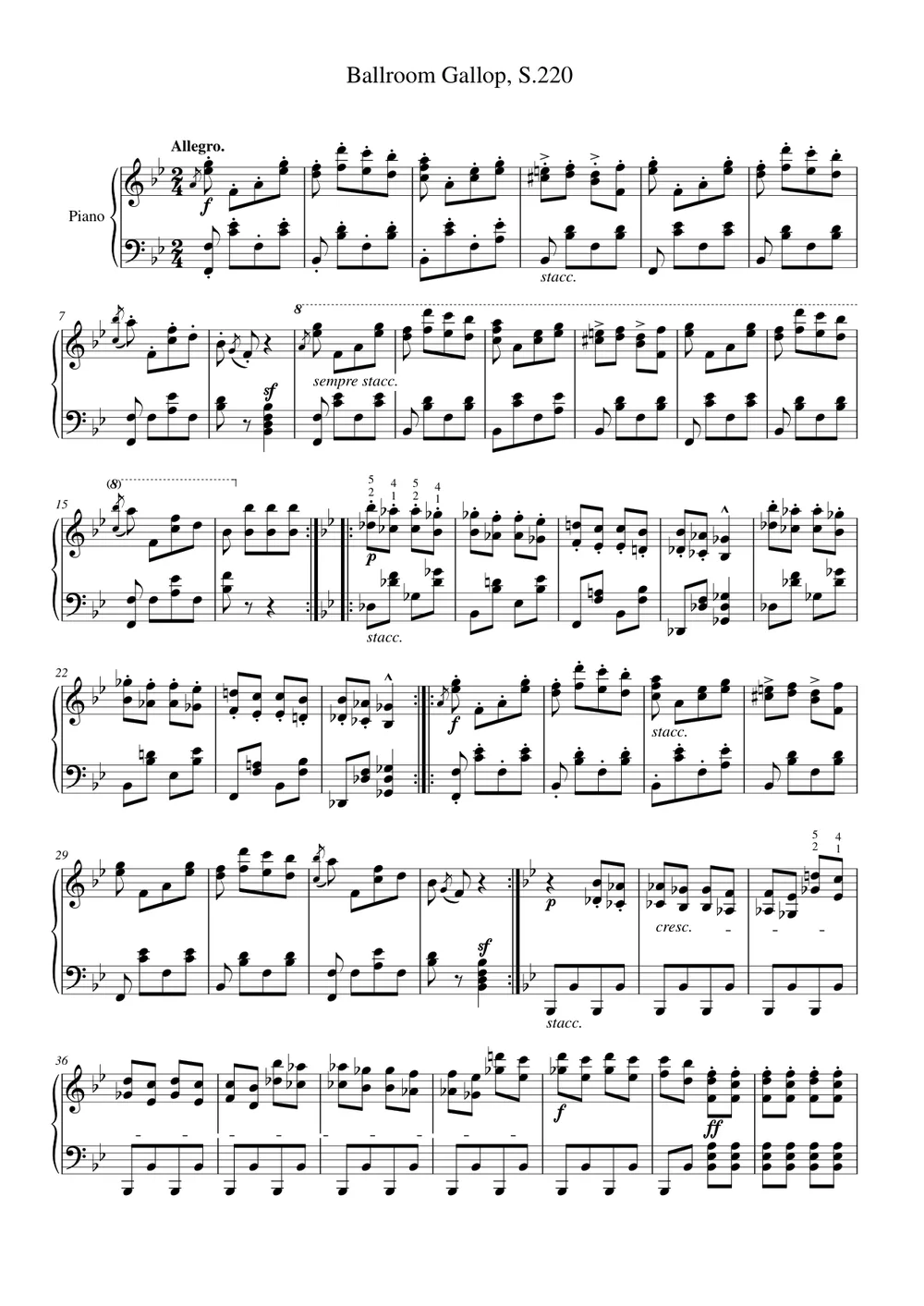
Ballroom Gallop, S.220 arranged for piano in C Minor (4/4, 66 BPM), graded Beginner. Complete printable 2-page PDF score for solo piano.
Sheet Music Preview
Urtext Notation • Page 1 Preview
Score Details
BeginnerDownload Piano Sheet Music
Personal Study Reference • 17 U.S.C. § 107 Fair Use • A4 Printable
Complete 2-page printable score prepared for instant download.
Chords & Harmony
Piano • GuitarPerformance & Study Notes
Harmonic structure, tempo guidance, and rehearsal notes for Ballroom Gallop, S.220
Pianistic Demands & Targeted Drills
Pedagogically suited for Beginner students (novice keyboard curriculum (Alfred Level 1 / Bastien Primer)), this piece develops essential touch control. Key challenges focus on finding middle C quickly and coordinating simple two-hand question-and-answer melodies. In sections with transparent two-part polyphony and classical Alberti motion, maintain flexible forearm rotation to prevent stiffness. Pedaling requirement: use light, shallow pedaling to enhance acoustic warmth without muddling inner voices. Practice Tip: play hands separately at 60 BPM while naming note names aloud to solidify keyboard geography.
Musicological Profile & Work Heritage
Rooted in the Romantic expressive piano literature, Ballroom Gallop, S.220 stands as a representative work by Liszt. The publication presents 2 pages totaling 37 notation measures, cross-checked against critical 19th-century piano folios. Digital music repositories index this composition under ISWC `T-2F0.43C.AB-1`.
Key Architecture & Chord Trajectory
The piece operates in C Minor, governed by a signature with three flats (B♭, E♭, A♭, with B♮ raised leading tone). This tonal center positions C as the primary acoustic anchor, while E-flat Major and the dominant G Major supply contrasting tonal colors. Harmonically, the progression Cm → Dm → G → C → F → E7 cycles smoothly through harmonic steps (F, E7) back toward the tonic. In terms of hand topography, C Minor yields an intense heroic key signature that commands deep shoulder weight on dramatic downbeat chords.
Time Signature & Temporal Dynamics
Metric propulsion relies on 4/4 (simple quadruple meter), giving the piece a well-proportioned metric pulse alternating primary and secondary stresses across the measure. Set to a metronome speed of ♩ = 66 BPM (*Andante maestoso*), the overall character feels unhurried with noble cantabile phrasing. Pianists should ensure that they listen for the overarching four-bar hypermeter to keep phrases singing rather than measure-bound.
Practical Application & Transposition Benchmarks
When programming this selection, music educators frequently schedule Ballroom Gallop, S.220 for formal piano masterclasses, recital auditions, and degree juries. The default key of C Minor suits standard instrumental ranges. Vocalists seeking a lower tessitura can transpose down to B-flat Minor, while high-register singers modulate up to D Minor. B♭ brass transpose to D Minor. From an attribution perspective: This publication provides an authorized instructional text under `unknown_needs_review` guidelines for private piano study.
Repertoire Matrix & Anthologies
Harmonically compatible pieces, graded level progression, and curated songbook collections.
Peaceful & Relaxing Piano Solos (Study, Focus & Mindfulness)
Download peaceful, relaxing piano sheet music PDFs. Featuring River Flows in You by Yiruma, Ludovico Einaudi, Yann Tiersen, Satie Gymnopedie, Debussy, and...
Frequently Asked Questions (FAQs)
01.Where can I download Ballroom Gallop, S.220 sheet music for free?
You can download the complete 2-page printable A4 vector PDF of Ballroom Gallop, S.220 for free directly on Pianist Forum with no subscription required.
02.What key, meter and tempo is Ballroom Gallop, S.220 composed in?
Ballroom Gallop, S.220 by Liszt is composed in the key of C Minor, set to 4/4 time signature, with an authentic performance tempo of 66 BPM.
03.What is the piano difficulty level of Ballroom Gallop, S.220?
This arrangement is rated at an Beginner level, featuring authentic harmony across approximately 37 measures.
04.Does this arrangement include complete harmonic chords?
Yes. This arrangement provides comprehensive harmonic chord symbols and standard musical notation. It is fully adaptable for solo piano performance, guitar accompaniment, organ, and instrumental ensembles.
Recommended Repertoire: Liszt & Classical
Free printable piano sheet music curated from Liszt and similar Classical compositions.

Ambre's Wedding
Liszt
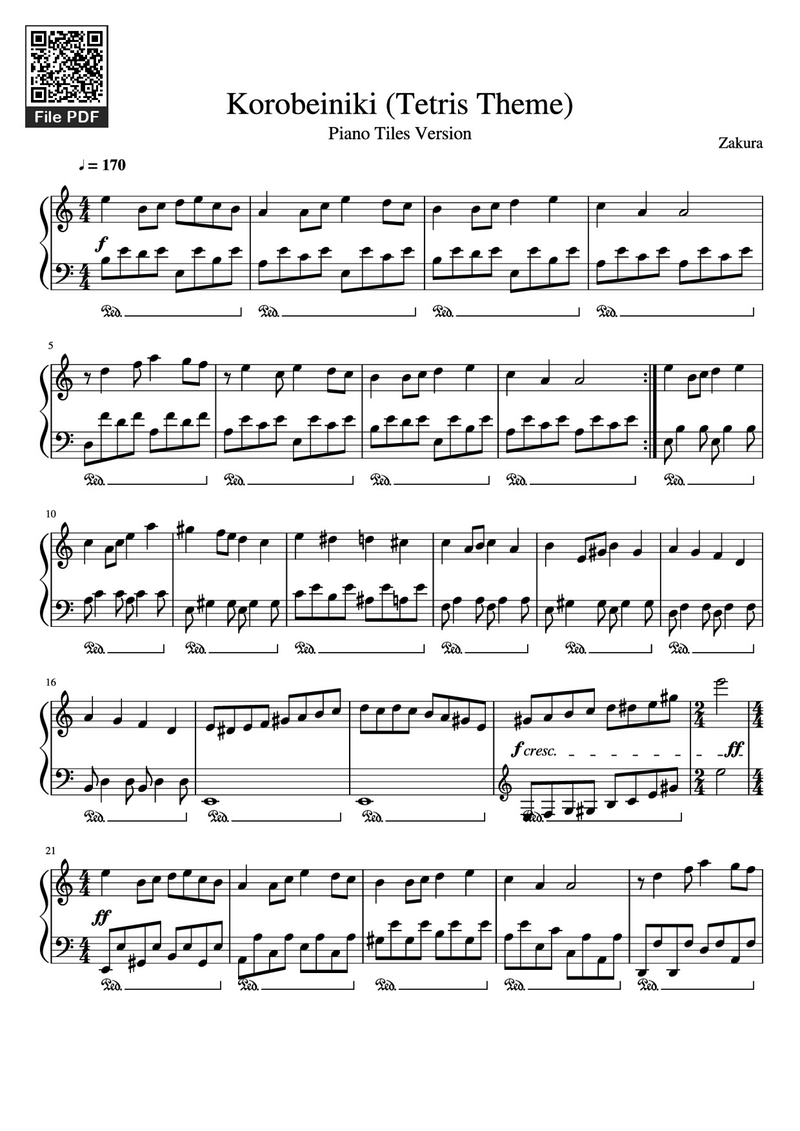
Tetris Theme
Liszt

Banana
Classical Master
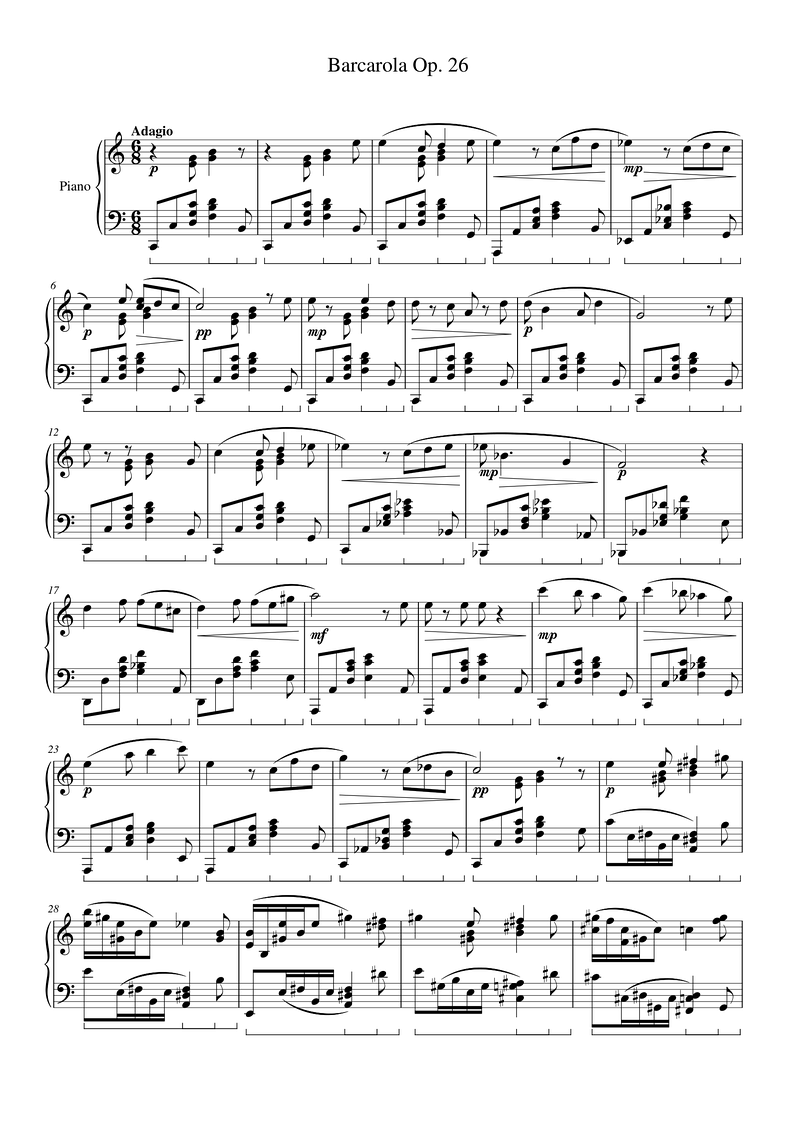
Barcarola Op. 26
J. C. Dovicchi
| # | Composition • Composer | Action |
|---|---|---|
| 1 | Ambre's Wedding Liszt • Same Artist | Score → |
| 2 | Tetris Theme Liszt • Same Artist | Score → |
| 3 | Banana Classical Master | Score → |
| 4 | Barcarola Op. 26 J. C. Dovicchi | Score → |
| 5 | Barcarole Borghild Holmsen | Score → |
| 6 | Barcarolla Sz. 81 No. 2 - Béla Bartók | Score → |
| 7 | Barcarolla op.1 Luca Timpano | Score → |
| 8 | Barcarolle Clachel Cliffgray | Score → |
| 9 | Barcarolle Dunngie Galswis | Score → |
| 10 | Barcarolle Gurlitt | Score → |