
09B
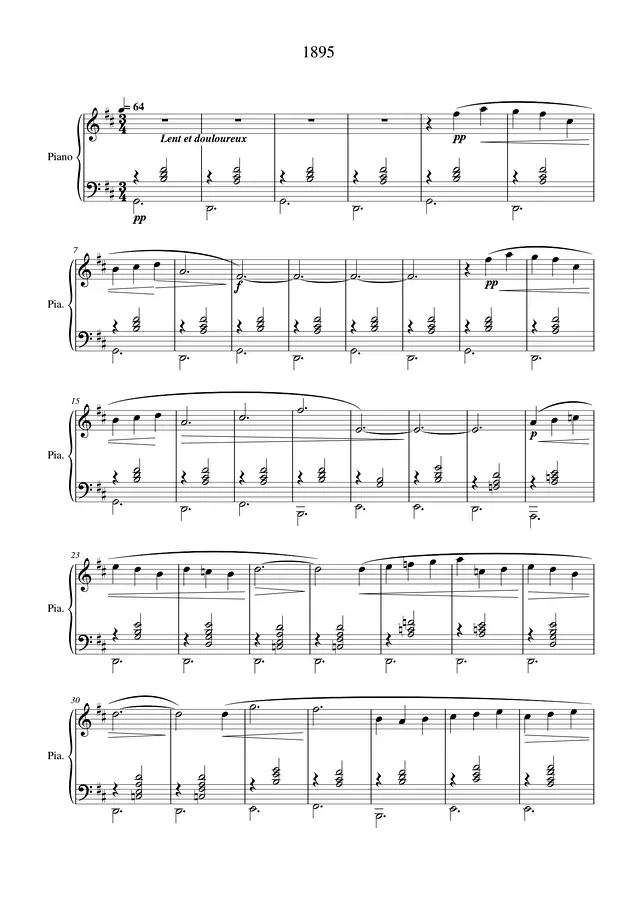
09B arranged for piano in B-flat Major (4/4, 129 BPM), graded Intermediate. Complete printable 3-page PDF score for solo piano.
Sheet Music Preview
Urtext Notation • Page 1 Preview
Score Details
IntermediateDownload Piano Sheet Music
Personal Study Reference • 17 U.S.C. § 107 Fair Use • A4 Printable
Complete 3-page printable score prepared for instant download.
Chords & Harmony
Piano • GuitarPerformance & Study Notes
Harmonic structure, tempo guidance, and rehearsal notes for 09B
1. Work Provenance & Archival Genesis
Within the Pianist Forum Conservatory Edition, the work identified as “09B” by Erik Satie should be approached through the broader aesthetic lens of Satie's mature artistic language rather than through assumptions of Romantic monumentality. Satie's compositional identity is distinguished by economy of means, deliberate clarity of texture, understated irony, modal coloration, and an often deceptively simple surface that conceals refined structural balance. Even when a score presents itself as technically intermediate, the interpretive demands frequently exceed the purely mechanical requirements.
The designation *09B* suggests a catalogued or editorially organized item rather than a universally recognized concert title. Consequently, the performer benefits from treating the score as an archival artifact whose value resides in its internal construction rather than external programmatic associations. In the Satie tradition, economy of notation often places heightened responsibility upon the pianist. Seemingly straightforward phrases require meticulous attention to touch, timing, pedaling, and tonal gradation. The absence of overt virtuosity should never be mistaken for interpretive simplicity.
The notated framework of B-flat major, 4/4 meter, and a relatively active tempo indication of 129 creates an intriguing context within Satie's aesthetic world. Such a configuration suggests music that balances poise with forward motion, requiring the performer to preserve transparency while maintaining rhythmic vitality. From a historical-performance perspective, the pianist should resist excessively Romantic rubato, exaggerated dynamic inflation, or thick pedal saturation. The primary artistic objective is to reveal structural clarity and subtle wit through disciplined control of sonority.
The score's three-page engraving length further implies a compact formal design. In short-to-medium Satie works, brevity often intensifies the importance of motivic recurrence, harmonic nuance, and proportion. Every phrase ending, registral shift, and textural adjustment acquires greater architectural significance because there is little redundant material. A conservatory-level performance therefore depends on projecting long-line continuity across a concise span without over-interpreting individual gestures.
2. Tonal Architecture & Harmonic Trajectory
The tonal center of B-flat major provides a fundamentally stable and luminous harmonic environment. From a structural standpoint, the performer should understand not merely the home key itself but the hierarchy of relationships radiating from it. The dominant region, F major, functions as the primary source of harmonic propulsion, while the subdominant sphere, E-flat major, frequently serves as an area of relaxation, expansion, or coloristic contrast. The relative minor, G minor, introduces the potential for introspection and expressive shadow without abandoning tonal coherence.
A sophisticated reading of the score begins by tracing how phrases confirm, delay, or destabilize B-flat major. Intermediate-level pianists often focus exclusively on note accuracy; advanced musicians instead identify points of tonic affirmation and harmonic tension. Whenever dominant-function sonorities emerge, the performer should shape them as genuine gravitational forces pulling toward resolution. Conversely, passages oriented toward the subdominant domain should often be allowed greater breadth and tonal warmth.
Voicing choices must reinforce harmonic hierarchy. Chords are rarely collections of equal tones. The upper melodic strand generally carries the principal rhetorical argument, while interior notes provide harmonic substance. In B-flat major textures, particular care should be taken whenever melodic tones outline scale degrees 3 (D), 5 (F), or 1 (B-flat), as these pitches frequently act as structural anchors. The soprano line should project with vocal inevitability, never through force but through tonal focus and weight distribution.
If episodes move through relative or neighboring key areas, the pianist should subtly adjust color rather than volume. Modulation is principally a change of harmonic light. A passage leaning toward G minor benefits from a slightly deeper key attack and marginally darker pedal resonance. Returns to B-flat major should feel like renewed acoustic clarity rather than merely louder dynamics. Such differentiation transforms harmonic events into perceptible narrative milestones.
The most convincing performances reveal harmonic motion beneath the surface rhythm. Listeners should sense the breathing of the tonal plan and the continual interaction between stability and departure. This underlying harmonic awareness elevates the interpretation from competent execution to genuine musicianship.
3. Metric Design, Pacing & Agogic Phrasing
The 4/4 meter provides a balanced metric framework, yet mature performance requires recognizing that not all beats possess equal rhetorical significance. In conservatory training, the pianist learns to distinguish between mechanical pulse and musical pulse. The former is constant; the latter expands and contracts according to phrase direction, harmonic momentum, and melodic intention.
At the indicated tempo of 129, pacing becomes particularly important. Excessive rigidity can render the music anonymous, while uncontrolled elasticity can undermine structural coherence. The ideal interpretation maintains a dependable underlying beat while allowing minute agogic inflections at moments of arrival, suspension, or cadential release. Such flexibility should emerge organically from phrase structure rather than from arbitrary expressive intervention.
Phrase shaping must be conceived vocally. The performer should identify each phrase's point of departure, trajectory, and destination. As melodic lines ascend, a gradual accumulation of tonal energy is often appropriate; as lines descend toward cadential resolution, controlled relaxation usually follows. These micro-architectures of tension and release create expressive continuity across the entire work.
Hand coordination plays a central role in metric clarity. In passages where accompaniment patterns support a singing upper voice, the rhythmic placement of the accompaniment should remain exceptionally stable. Any agogic freedom should be led by the melodic line and absorbed by the supporting texture. This principle preserves ensemble integrity between the hands while allowing expressive flexibility.
Cadential zones deserve special attention. Intermediate pianists often accelerate unconsciously through releases or slow prematurely before them. A more refined approach permits the harmonic rhythm itself to determine pacing. Slight broadening at structurally significant arrivals can be effective, provided that forward momentum is immediately reestablished. The listener should experience natural inhalation and exhalation rather than obvious tempo manipulation.
The finest interpretations create the illusion that every phrase unfolds inevitably. Meter remains perceptible throughout, yet never dominates the expressive discourse. The musical line appears to breathe freely while remaining firmly rooted in its underlying pulse.
4. Technical Hurdles, Voicing & Damper Pedaling
Although classified as intermediate in technical difficulty, the principal challenges of this repertoire lie in control rather than virtuosity. The greatest obstacle is often maintaining an elegant hierarchy between melody and accompaniment. The right hand must project the soprano voice with clarity and refinement while preventing accompanying tones from obscuring the melodic contour.
Effective hand alignment begins with balanced arm support rather than isolated finger effort. The pianist should establish a stable fulcrum around the stronger central fingers, particularly fingers 2 and 3, while allowing fingers 4 and 5 to sing without tension. When melodic material appears in the uppermost voice of chordal textures, a slight transfer of weight toward the melodic finger helps ensure projection without percussiveness.
In scale-derived passages, fingering should prioritize continuity of line over purely mechanical convenience. Smooth thumb crossings are especially important in B-flat major, where black-key geography naturally invites rotational motion of the forearm. Efficient lateral movement reduces vertical effort and promotes a more legato sonority. Any abrupt lifting action risks disrupting the characteristic elegance associated with Satie's style.
Left-hand accompaniment patterns require disciplined dynamic restraint. Many performers mistakenly equate clarity with prominence. In reality, accompanimental figures should function as harmonic atmosphere. The left hand supplies support, direction, and color, but seldom competes with the melodic register. Practicing accompaniment alone at pianissimo can cultivate the necessary tonal control.
Voicing within both hands should be approached polyphonically. Even when textures appear homophonic, individual strands possess differing levels of importance. The performer should learn to hear three layers simultaneously: the principal melody, interior harmonic support, and bass foundation. Each layer must occupy its own acoustic space.
Damper pedaling demands comparable sophistication. Because harmonic clarity is central to this style, pedal application should generally follow harmonic rhythm rather than metric regularity. Pedal changes synchronized with chord changes help preserve transparency. Half-pedal or fractional pedal techniques are particularly useful when resonance is desired without harmonic blurring.
At the tempo of 129, over-pedaling becomes especially hazardous. Resonance should enrich the sonority, not conceal articulation. In passages containing harmonic shifts through dominant or relative-minor regions, slightly more frequent pedal renewal often yields superior clarity. Conversely, stable tonic passages may tolerate longer resonant spans. The guiding principle is always acoustic balance: enough pedal to connect, never enough to obscure.
5. Practical Repertoire Placement & Performance Insights
Within the Pianist Forum Conservatory Edition, this work occupies a valuable position in the progression from foundational intermediate repertoire toward more nuanced artistic literature. While the technical demands remain accessible to developing pianists, the interpretive requirements introduce many of the refined skills expected at higher levels: voicing control, harmonic awareness, tonal differentiation, pedaling judgment, and stylistic restraint.
As a pedagogical study, the piece serves exceptionally well for developing melodic projection above accompanimental textures. Students who can execute larger virtuoso works often struggle with this more subtle discipline. Consequently, the repertoire functions as an important corrective, emphasizing listening skills and tonal refinement over speed-oriented display.
In recital programming, a concise Satie work in B-flat major can function effectively as a point of contrast. Its transparency offers relief from dense Romantic writing and creates an opportunity for audiences to appreciate nuance rather than spectacle. The performer should cultivate a stage presence that mirrors the musical language: poised, economical, and confident without exaggeration.
Preparation strategies should prioritize slow practice with active listening. The most productive questions are not merely "Are the notes correct?" but rather "Which voice matters most?", "Where is the harmonic destination?", and "What degree of resonance best serves the phrase?" Such inquiries transform technical practice into artistic preparation.
Ultimately, a distinguished performance emerges from disciplined understatement. The pianist who resists excessive sentimentality, carefully shapes the tonal architecture of B-flat major, maintains rhythmic poise within the 4/4 framework, and employs refined voicing and damper-pedal control will reveal the music's true sophistication. What appears modest on the page can, in expert hands, achieve remarkable elegance, clarity, and expressive depth. This is the enduring lesson offered by the repertoire and the interpretive standard advocated by the Pianist Forum Conservatory Edition.
Repertoire Matrix & Anthologies
Harmonically compatible pieces, graded level progression, and curated songbook collections.
Easy Erik Satie Piano Songs for Beginners (Printable PDF & Letter Notes)
Learn how to play Erik Satie on piano with easy arrangements for beginners. Free printable PDF scores with fingering and chord charts.
Erik Satie Sacred Choral Transcriptions Piano Collection (Printable PDF)
Download verified Erik Satie Sacred Choral Transcriptions piano sheet music in PDF and MusicXML. Graded conservatory editions with practice guides.
Erik Satie Preludes & Impromptus Piano Collection (Printable PDF)
Download verified Erik Satie Preludes & Impromptus piano sheet music in PDF and MusicXML. Graded conservatory editions with practice guides.
Erik Satie Virtuoso Piano Solos & Concert Repertoire (Concert PDF)
Master advanced Erik Satie piano works with authentic concert editions. Master A4 vector PDF scores for conservatory recital performance.
Erik Satie Virtuoso Etudes & Studies Piano Collection (Printable PDF)
Download verified Erik Satie Virtuoso Etudes & Studies piano sheet music in PDF and MusicXML. Graded conservatory editions with practice guides.
Erik Satie Essential Piano Sheet Music Collection (Free PDF & Chords)
Download verified Erik Satie piano sheet music in PDF and MusicXML. Graded classical and contemporary arrangements with chords and lyrics.
Frequently Asked Questions (FAQs)
01.Where can I download 09B sheet music for free?
You can download the complete 3-page printable A4 vector PDF of 09B for free directly on Pianist Forum with no subscription required.
02.What key, meter and tempo is 09B composed in?
09B by Erik Satie is composed in the key of B-flat Major, set to 4/4 time signature, with an authentic performance tempo of 129 BPM.
03.What is the piano difficulty level of 09B?
This arrangement is rated at an Intermediate level, featuring authentic harmony across approximately 58 measures.
04.Does this arrangement include complete harmonic chords?
Yes. This arrangement provides comprehensive harmonic chord symbols and standard musical notation. It is fully adaptable for solo piano performance, guitar accompaniment, organ, and instrumental ensembles.
Recommended Repertoire: Erik Satie & Classical
Free printable piano sheet music curated from Erik Satie and similar Classical compositions.

Gymnopedie No1
Erik Satie

3 Gymnopédies
Erik Satie

3 Morceaux en forme de poire, 1 Manière de commencement
Erik Satie

ANTONIO09B
Erik Satie
| # | Composition • Composer | Action |
|---|---|---|
| 1 | Gymnopedie No1 Erik Satie • Same Artist | Score → |
| 2 | 3 Gymnopédies Erik Satie • Same Artist | Score → |
| 3 | 3 Morceaux en forme de poire, 1 Manière de commencement Erik Satie • Same Artist | Score → |
| 4 | ANTONIO09B Erik Satie • Same Artist | Score → |
| 5 | 1.1 iambach | Score → |
| 6 | 11 Ecossaises, D. 781 Franz Schubert | Score → |
| 7 | 12 Etudes, Op. 25 No. 2 in F Minor F. Chopin | Score → |
| 8 | 12 Fugues, Voluntary 1 George Frideric Handel | Score → |
| 9 | 12 Fugues, Voluntary 5 George Frideric Handel | Score → |
| 10 | 12 Preludii mici No 2 Johann Sebastian Bach | Score → |